wachuma
silkscreen, 2015
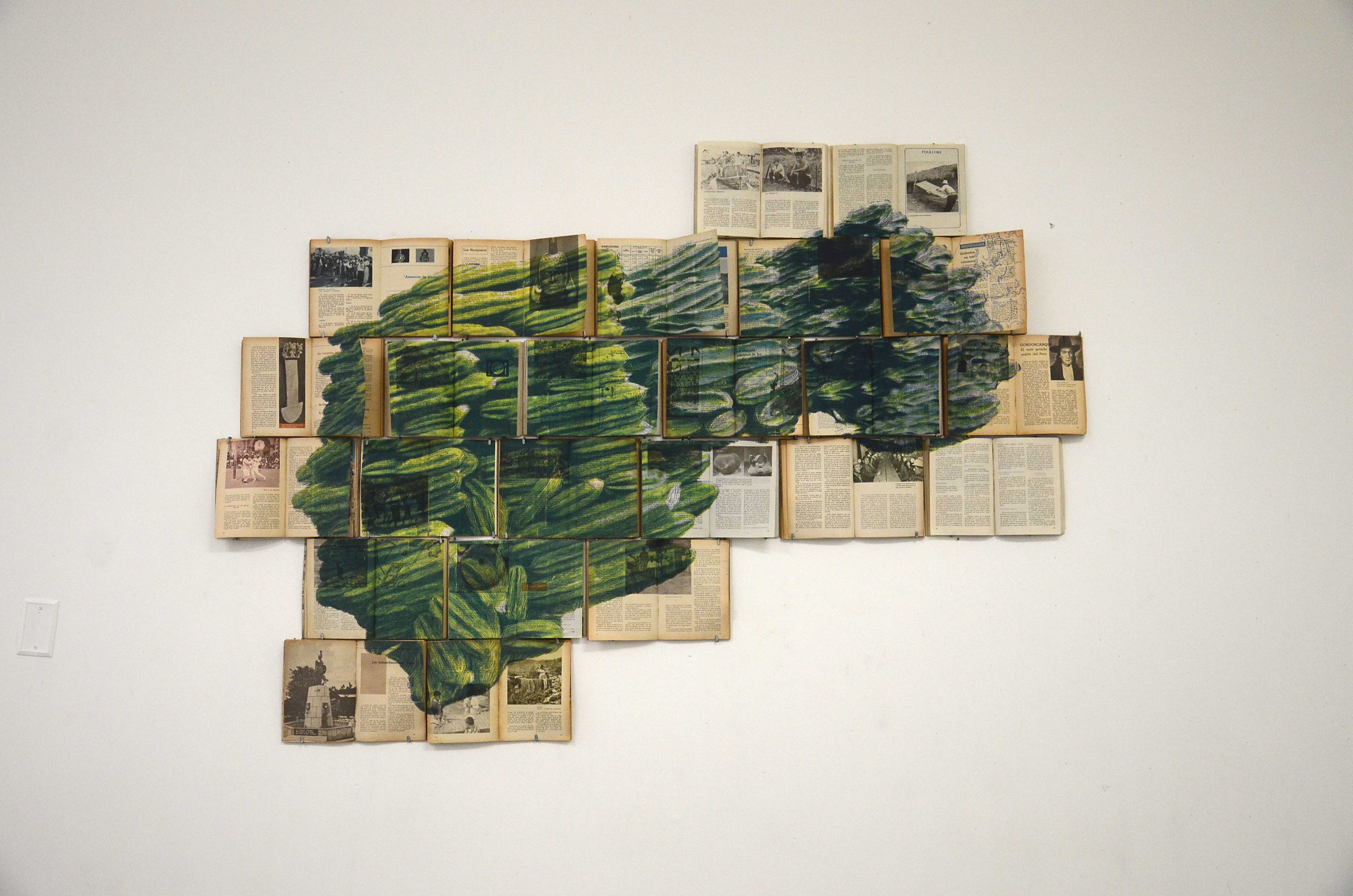
This work consists of a silkscreen print depicting a group of cut and stacked cacti—among them wachuma, an andean sacred plant—superimposed onto the complete 24-volume set Documental del Perú, first published in the 1970s. This encyclopedic collection was the Peruvian state’s first attempt to disseminate an image of a diverse, multicultural nation as part of the public policies implemented during the government of Juan Velasco Alvarado.
The piece emerged from a research process on the persistence of Andean worldviews along the coastal city of Lima, where waves of rural-to-urban migration in the 1960s and 1980s reshaped the presence and transformation of Andean traditions in the capital. During this investigation, I encountered the work of Italo-Peruvian anthropologist Mario Polia, who documented—after years of living in the northern Andes—that the ritual ingestion of San Pedro (wachuma) was understood as a practice that structured social relations. Through the ritual, the healer accessed the “realm of shadows,” a space in which individual ailments were addressed in relation to the community to which the patient belonged.
By printing the image of commercially harvested cacti directly onto this state-issued encyclopedic project, I sought to reveal the continued presence of Andean epistemologies rooted in the knowledge of the vegetal world—knowledge that persists even as these plants are now increasingly consumed under urban logics, often stripped of their medicinal or ceremonial significance and repurposed as decorative objects. Their presence remains, however, a symbol of pre-Hispanic wisdom embedded in the territory.
In this sense, the work stages a tension between two ways of knowing the land: the colonial, logocentric epistemology embodied by the documentary encyclopedia, and a relational, visual, and eco-centered epistemology grounded in Andean understandings of the vegetal ecosystem.
CHRIS LUZA - PERÚ. - 2025